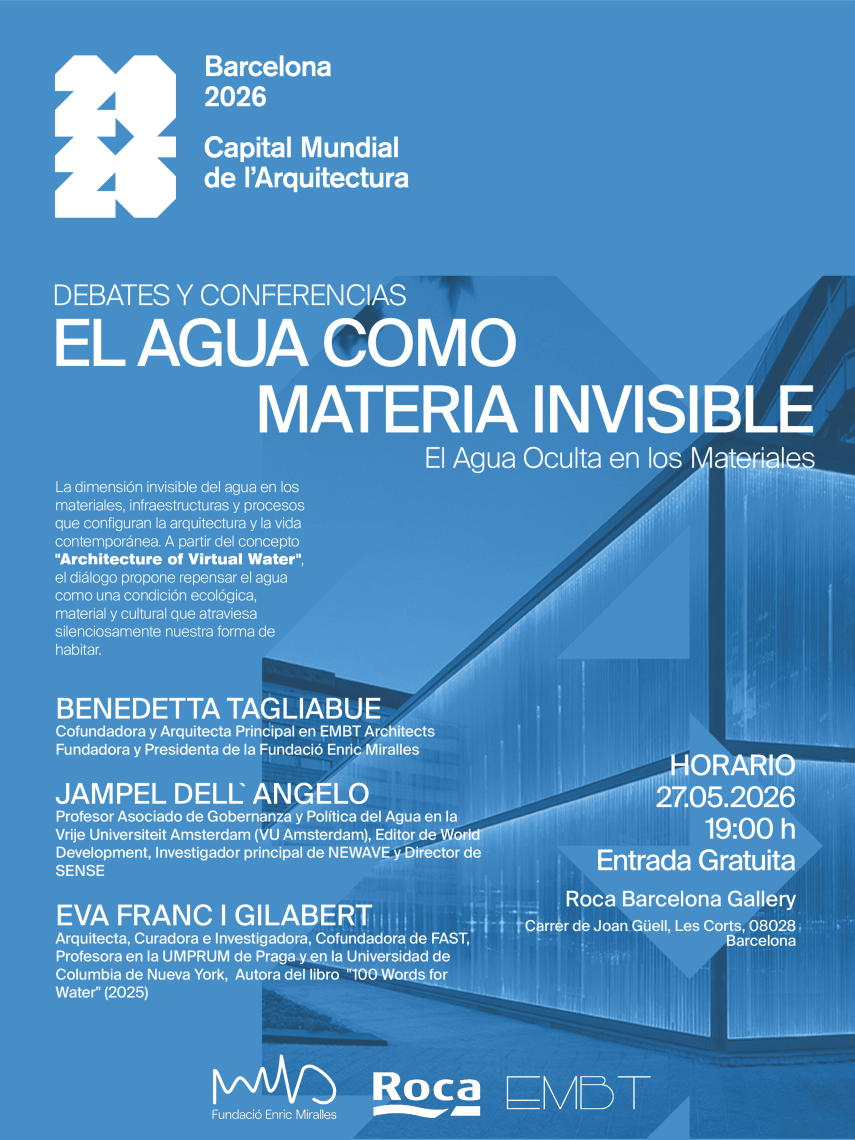
How much water is contained in what we cannot see?
Hidden Water in Materials
Wednesday, May 27 | 7:00 PM
ROCA Barcelona Gallery
Carrer de Joan Güell, Les Corts, 08028 Barcelona
Free admission
As part of the program “Architecture for Human, Urban and Planetary Wellbeing” of Barcelona World Capital of Architecture 2026, the Fundació Enric Miralles, together with ROCA Barcelona Gallery, presents the dialogue “Water as Invisible Matter”, a meeting that invites us to rethink the relationship between architecture, water resources and production processes from an environmental, material and cultural perspective.
This dialogue is based on a fundamental premise: much of the water that sustains our cities, materials and ways of life remains invisible. In this context, the concept of Architecture of Virtual Water emerges as a critical tool for understanding the real impact of design on ecosystems and on the production models that support contemporary architecture.
Developed by EMBT Architects for the Biennale Architettura di Venezia 2025 and now presented as a permanent installation at ROCA Barcelona Gallery for 2026, the pavilion Architecture of Virtual Water stems from research developed jointly with W a t e r s p a c e, a collaborative initiative co-curated with NEWAVE and promoted by the Fundació Enric Miralles. Through an immersive and multisensory experience, the project reveals the invisible flows of water embedded in materials, infrastructures and global production chains that sustain both contemporary architecture and our ways of inhabiting space.
In this context, the participation of Eva Franch i Gilabert, promoter of initiatives such as Water Parliaments and editor of 100 Words for Water, expands the discussion toward a cultural, political and speculative dimension of water. Her work proposes understanding water not only as a resource or infrastructure, but as an agent capable of reshaping contemporary imaginaries of architecture, territory and collective life, opening new forms of critical thinking around the ecologies of the future.
The question is no longer only how to manage visible water in buildings and cities, but how to understand and transform the invisible water footprint embedded in materials, production processes and global systems that shape both contemporary architecture and our ways of life.
Through dialogue between architecture, research and water governance, the session will explore how design can contribute to generating new forms of material awareness and environmental responsibility.


